Day trading, swing trading, trend trading. Same charts, same markets, three very different ways to use them.
People throw the labels around as if they were just marketing tags. In practise, the style you pick decides how often you trade, how long you sit in risk, what sort of drawdowns you see, and how your broker fees and funding charges pile up. It also decides how your daily routine looks.
Take three traders watching the same currency pair. One is flat by the end of each session. One holds for a few days, maybe a couple of weeks. One is only interested in the multi-month move that shows up clearly on the weekly chart. All three can be profitable, and all three can blow up, but they are playing different games using the same prices.
Thinking clearly about the difference between day, swing and trend trading is less about picking a “cool” label and more about being honest with yourself. Time horizon is a very basic choice, and once you lock that choice in, many other details follow almost automatically: which setups make sense, how you size positions, how you handle news, and what you need from your broker and platform.
The goal here is simple: pin down what each style actually means, how they differ in practice, and what that implies for traders who already know the basics and want to line up their behaviour with something coherent instead of mixing styles at random.
What day, swing and trend trading actually are
Start with plain definitions, not wishful thinking.
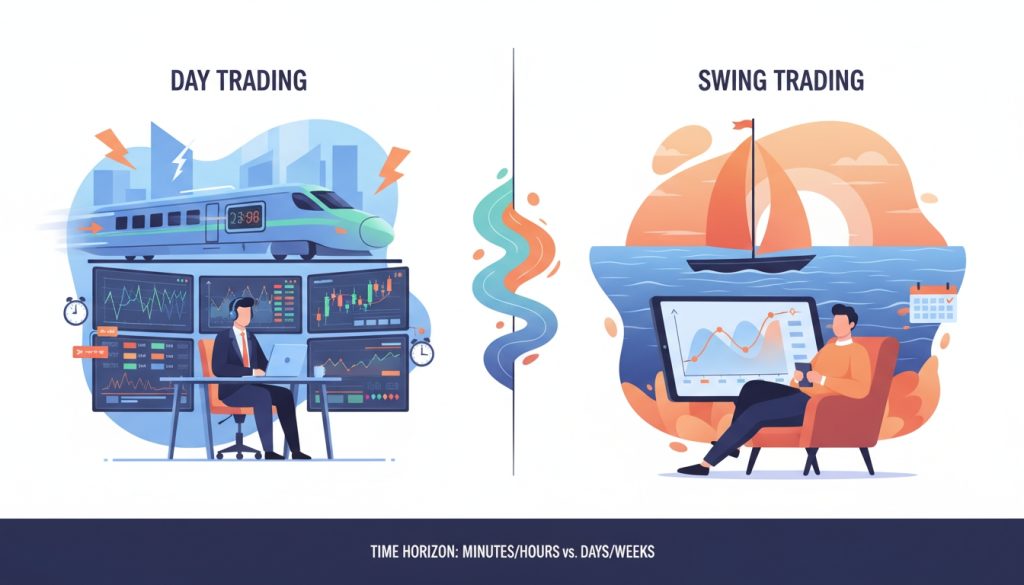
Day trading means you open and close trades within the same trading day, in that instrument. A pure day trader goes to bed flat in that product. That does not stop you holding other positions elsewhere, but the key feature is that you avoid overnight risk on the instruments you day trade. Holding period is measured in minutes to hours.
Swing trading stretches that horizon. Positions are held overnight and usually for several days, sometimes for a couple of weeks. The swing trader is trying to capture a “chunk” of a move: a leg in a trend, a mean-reversion swing back to a moving average, or a break from a consolidation. Holding period is measured in days, not minutes.
Trend trading pushes further out again. Here the focus is on multi-week or multi-month trends, often spotted on daily and weekly charts. The trend trader enters when they believe a larger move is underway and is willing to sit through many days of noise as long as the bigger directional move remains intact. Positions might run for months in slow markets.
In practise, there is overlap. A day trader may occasionally hold a position overnight when conditions are calm. A swing trader might exit earlier if the move completes faster than expected. A trend trader sometimes scales in and out on shorter swings within the major move. But the anchor for each style is the intended holding period and the sort of move they are trying to capture.
Once that is clear, the rest of the differences follow from the calendar and the clock.
Timeframes and holding periods: from minutes to multi-month trends
The most obvious difference sits in the chart timeframes that dominate your screen.
Day traders live on intraday charts. One-minute, five-minute, fifteen-minute and maybe an hourly chart for context. They care about opening auctions, order book shifts, intraday support and resistance, and short bursts of volatility around news releases. A daily bar is background noise unless they also hold longer-term positions.
Swing traders look at four-hour and daily charts first, then drop to lower timeframes just to refine entries and exits. They want to see where the market has been over the past few weeks, where obvious support and resistance zones lie, and how current price behaves relative to that structure. A noisy one-minute spike is not central; the close on the daily chart matters more. You can learn more about swing trading how swing trade is trade by visiting SwingTrading.com.
Trend traders usually start from the daily and weekly view. Some even ignore anything lower than daily. They look for higher highs and higher lows (or the reverse), broad channels, big bases, and breakouts from long consolidations. Once in a trade, they might use a daily moving average or weekly levels as their guide. Intraday wobbles are just that: noise.
This difference in timeframe has knock-on effects.
Day traders need markets that actually move within a session: index futures, active stocks, liquid FX pairs, short-dated options, intraday crypto moves. Swing traders can work with a wider set of instruments as long as there is enough range over a week or two to justify the effort. Trend traders often settle on broader indices, major pairs, sector ETFs and commodities where large, sustained moves happen from time to time.
Time horizon also changes how you experience news. Day traders are hyper-aware of intraday news timing, since a release can wreck or rescue a position in seconds. Swing traders pay attention to scheduled data, earnings and central bank meetings across their holding period. Trend traders care more about the big picture data that bends trends than about every small announcement.
In short, timeframes are not just about chart scale. They reflect how long you are willing to be wrong before admitting a mistake and how long you expect a typical winning trade to run.
Trade selection and setups: what each style tries to capture
Day, swing and trend traders often talk about similar concepts—breakouts, pullbacks, ranges—but they use them differently.
A day trader might trade a breakout from the first hour’s range in an index future. The idea is to catch intraday momentum as other traders pile into the move. Stops are tight, often just beyond the morning range. Targets might be previous day highs or lows, or a fixed intraday distance. The trader does not care what the weekly trend is; they just want the intraday extension.
A swing trader watching the same index might wait for a multi-day pullback in an uptrend, then buy as daily momentum turns back up. The initial stop might sit under the recent swing low on the daily chart. The target could be a retest of recent highs or a measured move from the previous leg. That trader is capturing a slice of the weekly trend, not the noise inside one day.
A trend trader might ignore both of those moves and only act when the index breaks to fresh multi-month highs after a long base. The stop can be wide, perhaps below the breakout zone on the weekly chart. The trader accepts that there will be pullbacks and aims to hold through them unless the larger structure breaks. Profit is taken when the trend clearly rolls over or when a predefined trailing stop is hit.
In range-bound markets, day traders try to fade intraday extensions, selling near temporary highs and buying dips inside the day. Swing traders might run mean-reversion systems that trade from one side of a multi-day range to the other. Trend traders often stand aside in such conditions, waiting for a clear break that marks the start of a fresh larger-scale move.
The common labels—breakout, pullback, reversal—hide the real difference: how much of the move each style aims to take. Day traders try to grab pieces of the intraday jiggle. Swing traders try to capture legs inside a broader move. Trend traders sit and wait for the big swing that is obvious only when you zoom out.
Position sizing, risk and trade management across the three
Time horizon shapes risk.
Day traders can often use tighter stops in point terms because they focus on intraday structure. A stop might sit a few ticks beyond a recent high or low on a five-minute chart. Because stops are closer, they can run relatively larger size per trade for the same account risk, at the cost of higher sensitivity to noise and slippage.
Swing traders usually set stops based on daily or four-hour structure, which means wider distances. A stop might sit under a swing low on the daily chart, under a key moving average or just beyond a clear support zone. To keep risk per trade sensible, position size must be smaller relative to account equity. Trade management often includes partial profit-taking and moving stops up as the trade works.
Trend traders often sit in trades with very wide stops, based on weekly chart levels or long-term moving averages. That forces even smaller positions if they want to keep account-level risk under control. On the other hand, if a trend runs for months, the profit potential can be many times the initial risk, which compensates for the low trade frequency.
There is also a difference in how many trades you run at once. Day traders may only hold one or two positions at the same moment, but they might enter and exit dozens of times per week. Swing traders often have a modest portfolio of open trades across several symbols and time zones. Trend traders may hold only a handful of positions but have a lot of equity tied up in each for long stretches.
Risk management tools vary.
Day traders rely heavily on hard stops, fast manual exits and, sometimes, hedging with correlated instruments during news events. They need clear rules on when to stop trading for the day after a run of losses or after hitting a profit target, to avoid revenge trading.
Swing traders lean on position sizing, diversification across instruments, and sensible use of stops and alerts. Because they hold overnight, they have to accept gap risk. Position size and selection must account for earnings dates, macro releases and weekend headlines.
Trend traders often use trailing stops based on volatility or simple rules such as “exit when price closes below the x-day moving average”. Their biggest risk is giving back large chunks of open profit in pullbacks, so they need a balance between letting the trend breathe and not handing back the entire move.
Across all three, the core idea stays the same: define risk before entry, size positions so that a run of losing trades does not wreck the account, and have a clear exit logic. The way you implement that changes with holding period.
Psychology and lifestyle fit: who tends to survive in each style
Time horizon affects how you spend your day and how your head feels.
Day trading is intense. You are glued to the screen while markets are open, especially at the most active times like the first hour of a stock session or key data releases in FX. Decisions are quick. Feedback is immediate. P&L swings can be sharp even within minutes. Some people thrive on that pace; others burn out or start over-trading as concentration fades.
To cope with day trading, you need a temperament that handles rapid decision making, frequent small losses, and the temptation to over-scale after a good run. Discipline in walking away after session-end is crucial, otherwise “just one more trade” creeps into every spare minute.
Swing trading is slower. You still watch markets, but you are not chained to every tick. You might spend more time planning trades after the close, placing orders and alerts, then checking in a few times during the day. This style fits better with a normal job or family schedule than pure day trading, but it demands comfort with holding risk through overnight periods and weekends.
Psychologically, swing traders need patience and the ability to sit through reasonable pullbacks without panicking, while still cutting losers when the setup breaks. There is also the challenge of boredom; there will be days when nothing sets up and the best action is no action.
Trend trading is slower again, almost boring when done well. Decisions are infrequent. Stops are wide. You must accept that you will not catch tops and bottoms; you are riding the middle part of large moves. The main psychological risk is tinkering: closing positions too early because it feels wrong to sit on big open profits, or jumping in and out of trades based on short-term noise that has nothing to do with the larger trend.
Lifestyle impact differs. Day trading is hardest to combine with a full-time job unless your job happens at odd hours or you trade markets in a different region. Swing trading is more compatible with a regular schedule. Trend trading can fit around almost anything, but you still have to set aside time to review positions and respond to rare but important events.
There is no “better” from a personality angle. The important question is which style your temperament and daily life can support without constant stress.
Costs, brokers and tools needed for each approach
The three styles stress different aspects of your broker and platform.
Day traders are very sensitive to per-trade costs. Spreads, commissions and slippage add up fast when you might enter and exit multiple times a day. A day trader needs tight spreads in their chosen instruments, low commissions, and good execution speed. Direct market access routes, reliable data feeds and stable platforms matter a lot. A single platform freeze during a volatility spike can undo a week of good work.
They also often need features like advanced order types, depth-of-market displays, and solid intraday charting tools. Real-time news feeds and event calendars are more important, because small intraday moves around headlines are part of their opportunity set.
Swing traders are less sensitive to per-trade costs but very sensitive to overnight funding and swap charges. Holding positions over days means that financing rates on CFDs, FX and margin positions can make a real dent in returns. They need clear, fair funding schedules and honest handling of corporate actions for single stocks and ETFs.
Platform needs are more modest. Reliable end-of-day data, decent daily and four-hour charting, and good order management (including good-til-cancelled orders and alerts) are more important than every intraday gadget. Reporting tools that make it easy to review trade history and performance across weeks and months are useful, since evaluation cycles are longer.
Trend traders stress the broker’s stability and custody more than anything. If you will hold a position for months, you care about the firm’s balance sheet, regulation, and how it handles dividends, stock splits, and corporate events. Cost per trade and even overnight funding matter, but across a six-month trend those are a smaller slice of the total P&L than the move itself.
They also benefit from broader research tools: screeners for trends on weekly charts, scans for new highs or lows, and basic fundamental data. Execution speed is less critical as long as slippage is not excessive, because entries and exits are rare.
Across all three, a bad broker can ruin good trading. But what “bad” means shifts. To a day trader, bad is a platform that hangs and a spread that widens randomly. To a trend trader, bad is a firm that handles corporate actions sloppily or runs into balance sheet trouble while you are sitting on a large position.
Choosing and combining styles without creating a mess
Many traders try to mix day, swing and trend trading in one account. In theory that is fine. In practise, without clear boundaries it often becomes a jumble where no style is applied consistently.
One way to avoid that mess is to pick a primary time horizon. Decide whether your core decisions will be made on intraday charts, daily charts, or weekly charts. That choice sets expectations about trade frequency, average holding period and typical stop size. You can still take trades on other horizons, but they should be clearly labelled in your own notes as “short-term tactical” or “long-term position” rather than all thrown into one bucket.
Another approach is to allocate parts of your capital or even separate accounts to each style. You might keep a small intraday futures account, a swing CFD or spot FX account, and a longer-term investment account for trend trades in ETFs. That separation makes it easier to measure how each style performs and stops a bad streak in one from pulling you into revenge trading in another.
Mixing styles inside a single chart can cause problems. A common pattern is entering with a day trading mindset, then converting a loser into a “swing trade” to avoid taking the loss, and finally calling it a “long-term position” when it drifts even further. The label keeps changing but the trade was never planned as a swing or a trend trade. That is how accounts end up full of underwater positions that no longer match any plan.
If you want to move from one style to another over time, it helps to treat it as a deliberate shift. For example, a trader might start as a day trader, realise that the lifestyle and cost structure do not suit them, and then rebuild their plan around swing trading on daily charts. That involves changing position sizing, broker expectations and performance metrics, not just flipping a label in a journal.
The styles can complement each other when used carefully. A trend trader might use short-term trades to fine-tune entries at points where longer-term signals line up. A swing trader might step back and hold a portion of a position for a trend move when the market behaves well. The trick is to keep the plan honest: each trade should have a clear time horizon from the start.
Thinking in “time horizons” instead of buzzwords
Day, swing and trend trading are just three answers to one basic question: how long do you want to hold risk in a trade.
Day traders live inside the session, hunting intraday movement and going flat before the close. Swing traders stretch that horizon to days and weeks, aim to capture segments of larger moves, and accept overnight gaps as part of the deal. Trend traders zoom out to weeks and months, trying to ride major moves at the cost of sitting through plenty of noise.
None of the three is automatically better. Each has its own cost pattern, psychological demands and broker requirements. The important part is that you pick a time horizon that fits your temperament, schedule and capital, then build your rules around that, instead of grabbing random ideas from all three camps.
If you treat time horizon as a core part of your trading identity rather than an afterthought, the labels start to matter less. You become a trader who usually holds for X days and manages risk in Y way, not just someone who says “I’m a swing trader” because it sounds neat on social media. That quiet clarity tends to help more than any fancy label ever will.